What is Rudder?
Rudder is a system infrastructure automation platform, dedicated to empowering IT operational teams to ensure and improve their security posture and fostering collaboration in Security Operations (SecOps).
Features
Security posture management: Automate critical IT operations to fortify infrastructure security: * Automated systems inventory * Patch management * Vulnerability management * System hardening and security standards compliance Configuration management: Streamline and automate configuration tasks for enhanced reliability, with advanced compliance visualization. Configuration policies can be created seamlessly using a visual editor, or YAML code. Multi-platform support: Manage diverse environments, including Cloud, hybrid, and on-premise setups, running on Linux or Windows. Scalable and Dynamic approach: A scalable and dynamic approach to infrastructure management, including a powerful hierarchical configuration data engine and automated classification of managed systems. Typical deployments manage 100s to 1000s of systems, and a single Rudder server can manage more than 10k systems.
A few things that make Rudder stand out:
-
A simple framework allows you to extend the built-in rules to implement specific low-level configuration patterns, however complex they may be, using simple building blocks (ensure package installed in version X, ensure file content, ensure line in file, etc.). A graphical builder lowers the technical level required to use this.
-
Each policy can be independently set to be automatically checked or enforced on a policy or host level. In Enforce mode, each remediation action is recorded, showing the value of these invisible fixes.
-
Rudder works on almost every kind of device, so you’ll be managing physical and virtual servers in the data center, cloud instances, and embedded IoT devices in the same way.
-
Rudder is designed for critical environments where a security breach can mean more than a blip in the sales stats. Built-in features include change requests, audit logs, and strong authentication.
-
Rudder relies on an agent that needs to be installed on all hosts to audit. The agent is very lightweight (about 90 Mb of RAM at peak) and blazingly fast (it’s written in C and takes less than 10 seconds to verify 100 rules). Installation is self-contained, via a single package, and can auto-update to limit agent management burden.
-
Rudder is a true and professional open source solution—the team behind Rudder doesn’t believe in the dual-speed licensing approach that makes you reinstall everything and promotes open source as little more than a “demo version.”
Rudder is an established project project, used in companies from small to biggest-in-their-field, as well as by hobbyists or open-source users. Typical deployments manage from 10 to 15000 nodes.
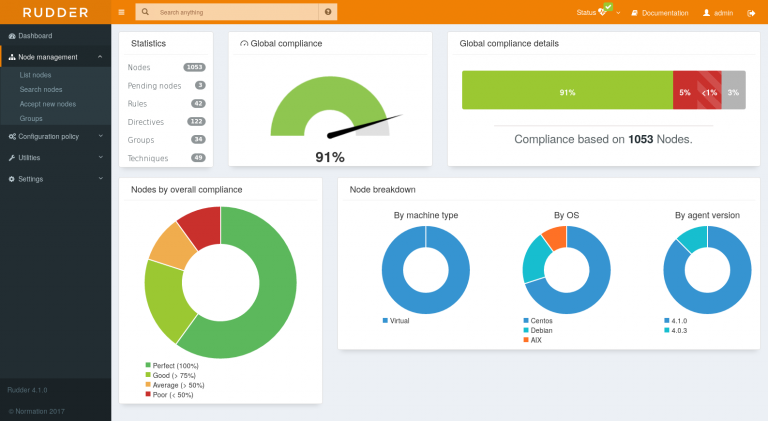
Made for production environments
We believe that there is a growing impedance mismatch between the Short Time of application development and deployment, and the Long Time of the infrastructure. The latter needs rationalisation, stability and conformity before catching the hyped techno of the day, to be able to deliver reliable technical platform, continuously working with a minimum of risks.
Rudder was made for the Long Time, to help team deliver efficient infrastructures with simplicity, giving them feedback where needed, keeping them alert of possible incoming problems, continuously checking conformity to their rules, and all of that whatever the infrastructure they choose to build.
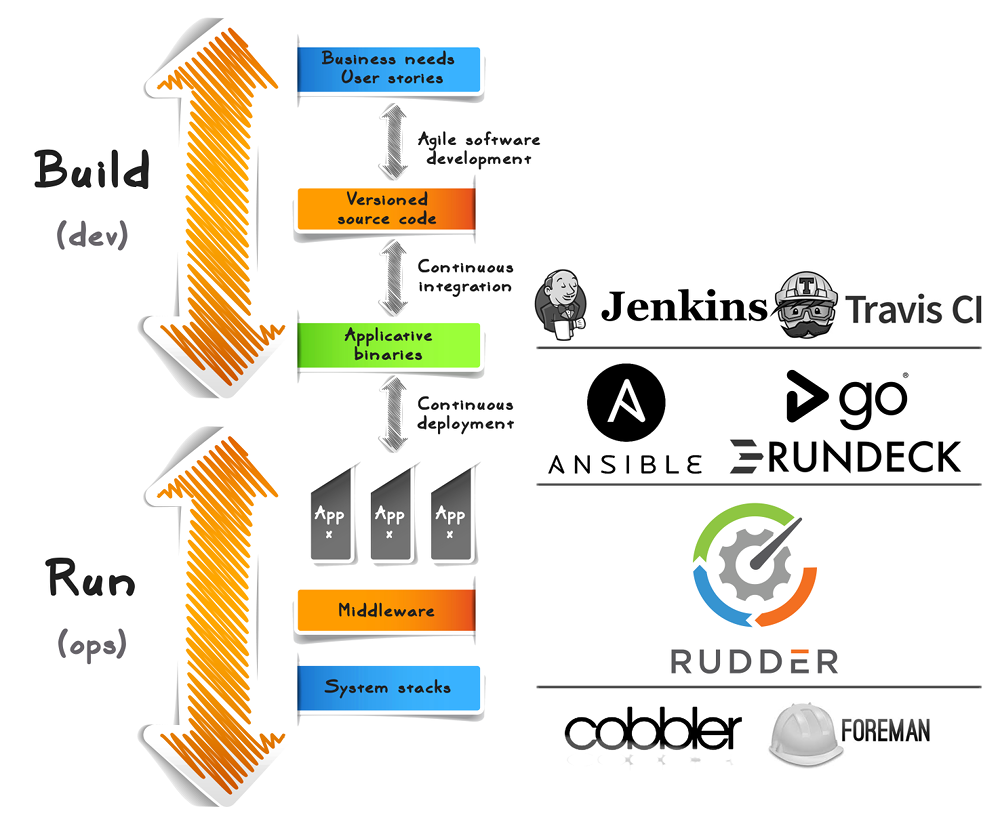
To achieve these goals, Rudder goes beyond simple automation of commands or configurations. Rudder continuously maintains your infrastructure to keep it conform with your configurations and security rules.
At each level (global, by configuration policy, by node, etc), you can choose to either Audit the component - and no modification at all will made on it -, or to Enforce the policy, automatically correcting a drift if needed.
Different roles for a better accessibility
Rudder was thought from the start for plug&play-ability: easy to install and to upgrade, easy to start with and growth with.
Rudder comes with a graphical interface, a standard library of configuration policy ready to use, and a graphical rule editor.
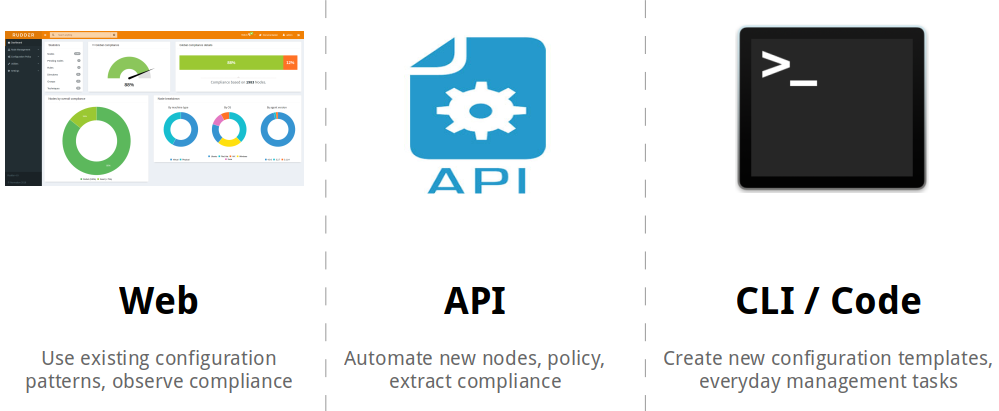
Developers can script Rudder through its APIs and security teams can check conformity level to their policies or inventory (both software and hardware) of a server at any time.
Universality
Rudder agent is extremely fast, light, and versatile. It works on a wide variety of OS or hardware, from physical server to cloud instance, user laptops or even Digital Cities and IoT objects.
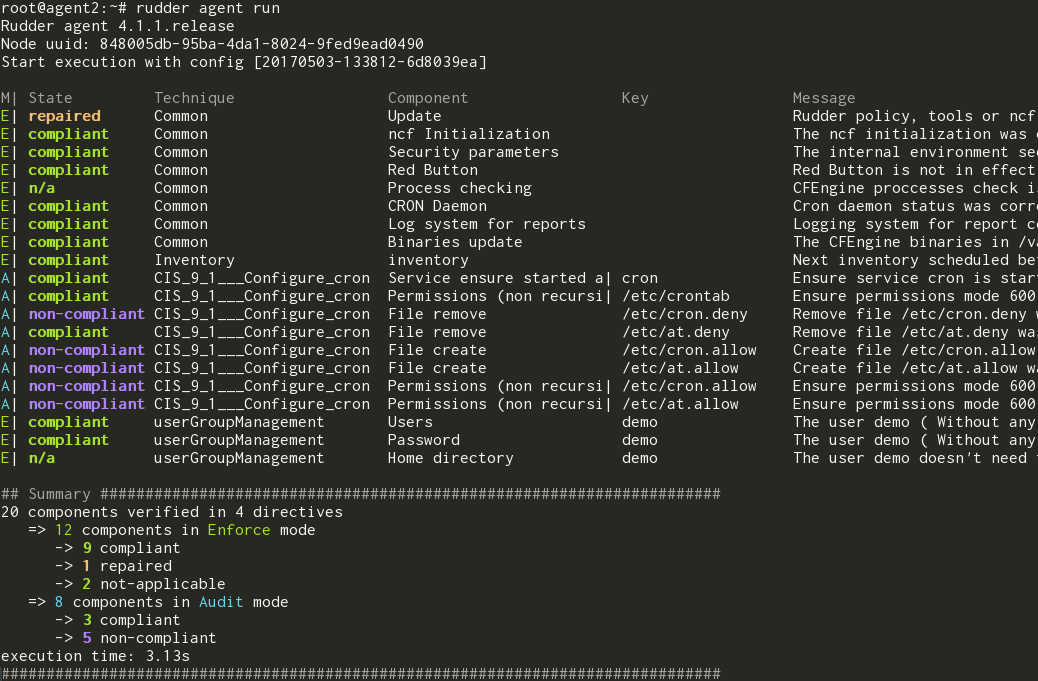
Key Features →